

Examino: the free artificial intelligence tool for teachers
What is Examino and how does it work?
Examino is an artificial intelligence solution that helps teachers grade handwritten papers. Its main advantage lies in its ability to quickly analyze student responses and generate accurate grades.
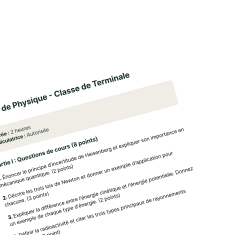
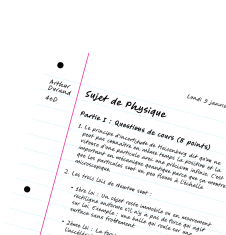
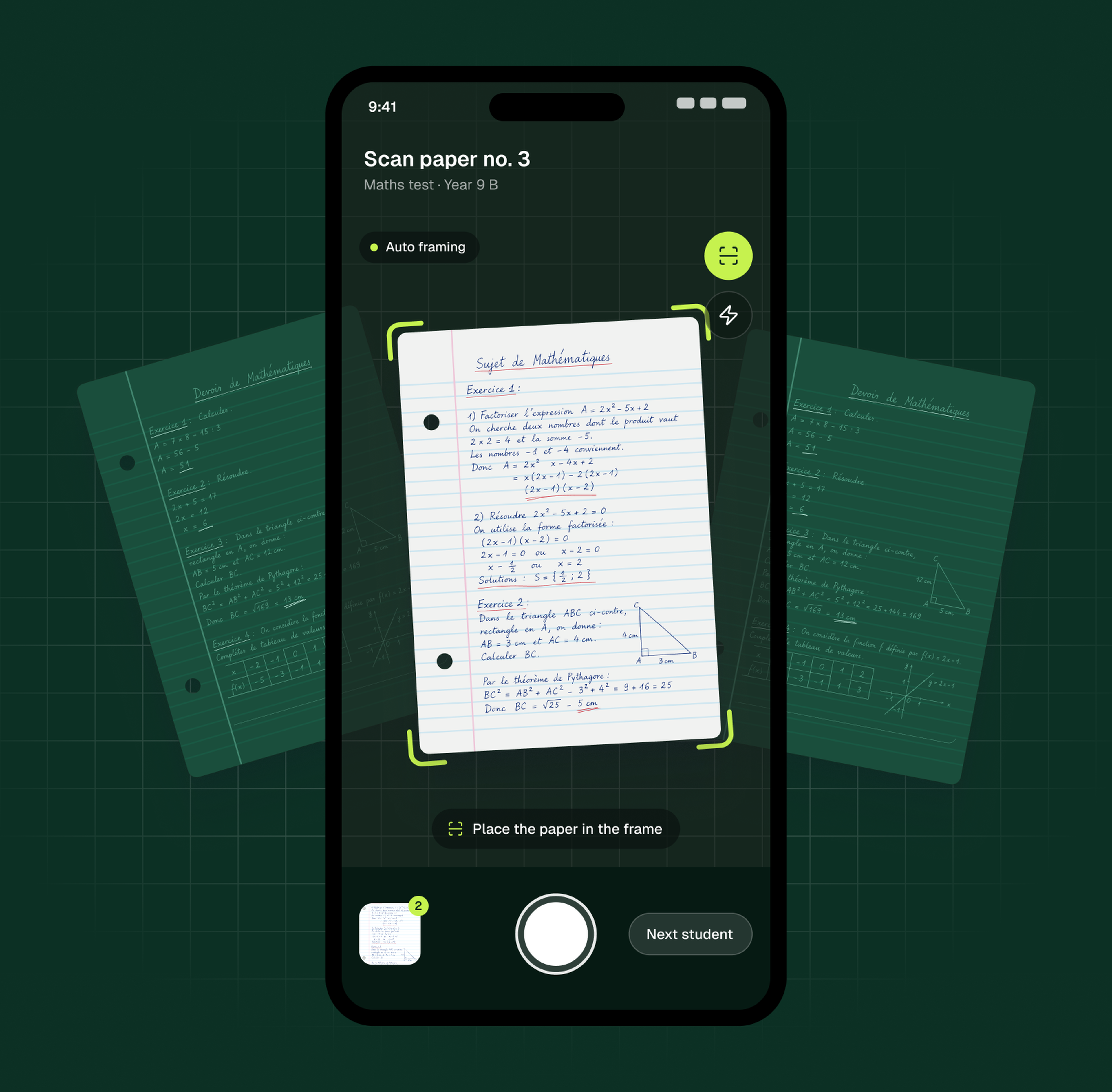
Examino's operation is based on a simple three-step process. First, the teacher imports the assessment subject in PDF format into the application. Then, they digitize the students' papers either by importing a scan or by using their smartphone's camera. The artificial intelligence then analyzes the content of the papers, whether it involves written texts, mathematical calculations, or even complex diagrams. The system identifies errors and applies the marking scheme predefined by the teacher. This entire process takes about 30 seconds per paper, allowing a hundred papers to be processed in less than 5 minutes.
The benefits of using artificial intelligence for grading
Automated grading with Examino offers a considerable time saving for teachers. This freed-up time (up to 6 hours per week) can be reinvested in personalized student support.
Beyond simple time savings, the use of this technology provides major pedagogical advantages. It significantly reduces the stress associated with intensive grading periods, especially during exams. Objectivity represents another significant advantage: the tool uniformly applies assessment criteria, eliminating unconscious biases that can affect even experienced teachers after several hours of grading. Furthermore, Examino facilitates the analysis of collective performance, allowing for the rapid identification of concepts poorly understood by the entire class or difficulties specific to certain student profiles.
Try Examino for free
The app lets you scan your handwritten papers using your smartphone to grade them with Artificial Intelligence.
Maximize your teaching impact by minimizing your grading workload.
Examino's free trial: what you need to know
Examino's free offer allows teachers to test all features of the application with a monthly quota of 10 papers. This plan grants access to all analysis and automated grading tools.
Comparison of Examino offers
| Feature | Free Version | Paid Versions |
|---|---|---|
Number of papers gradable per month | Up to 10 | 100 to 300 (depending on subscription) or more (Institution Plan) |
Access to all basic features | Yes | Yes |
AI-automated grading | Yes | Yes |
Export grades | Yes | Yes |
Unlimited management of classes and subjects | Yes | Yes |
Premium support | No | Yes (Institution Plan) |
Signing up for Examino is surprisingly simple. Creating an account only requires an email address and a password. Once logged in, the minimalist interface guides the user through every step of the grading process. No specific technical skills are required, making the tool accessible even to teachers unfamiliar with new technologies. To maximize efficiency, simply follow the guided process: select the grade level, import the subject, then the papers, and start grading. The application also allows for easy export of results to other educational tools.
Compatible subjects and grade levels
Examino adapts to a wide range of school and university disciplines. Designed for all levels, from primary school to higher education, the tool supports over 20 different subjects, thus covering the essential educational needs.
Here is an overview of subjects and disciplines covered by Examino, ranging from primary school to higher education.
Mathematics: From basic arithmetic to complex equations, Examino can analyze and grade calculations with precision.
Sciences: Physics, chemistry, biology – Examino is capable of evaluating diagrams, charts, and experimental data.
Languages: Literature, grammar, written expression – Examino can evaluate the quality of argumentation and expression, as well as check spelling and grammar.
History: Examino can verify the accuracy of dates and historical events, as well as evaluate the understanding of contexts and issues.
Law: Case analysis, interpretation of legal texts – Examino can help assess the understanding of concepts and legal rules.
Examino's flexibility regarding different types of assessment is one of its strengths. The artificial intelligence analyzes with equal efficiency multiple-choice questions, mathematical problems, literary essays, or historical document analyses. This versatility allows teachers to maintain their usual assessment methods without having to adapt their subjects to technological constraints. For each discipline, the tool offers specific recognition of notations and terminology unique to the field, thus ensuring relevant grading.

Other free artificial intelligence tools for teaching
Pedagogical content creation assistants
In addition to Examino, several free artificial intelligence tools help teachers create personalized educational content. These innovative resources allow enriching classes while saving precious time.
ClassPoint AI transforms your PowerPoint presentations into interactive quizzes based on Bloom's taxonomy, with multilingual support. Meanwhile, MagicSchool offers features for planning lessons and generating multiple-choice assessments. Edcafe AI, for its part, provides a complete suite for creating interactive resources such as flashcards or voice synthesis. These tools analyze your existing documents and automatically produce adapted educational content. Personalizing learning thus becomes accessible thanks to these assistants that generate differentiated materials according to student needs.
Artificial intelligence tools for assessment and feedback
Other assessment solutions complement Examino, such as Gingo and Gradescope, which offer specific features for analyzing and commenting on student work.
Gradescope stands out with its integrated plagiarism checker and personalized feedback features, available for all subjects. Its interface enables faster grading through partial automation of the assessment process. Unlike Examino, which excels in analyzing handwritten papers, Gradescope is particularly effective for online assessments. The combined use of these artificial intelligence tools for teaching offers a complete solution that adapts to different pedagogical contexts. Each platform presents distinct advantages depending on the assessment format and the teacher's goals.
Chatbots and AI assistants for pedagogical support
Large language models like ChatGPT, Gemini, and Claude offer free versions that significantly assist teachers in their daily work. These intelligent assistants allow for answering student questions, creating varied educational resources, and optimizing time-consuming administrative tasks. Their use easily integrates into the workflow of teachers looking to save time.
In the classroom, these artificial intelligence tools demonstrate their versatility through concrete uses. They generate differentiated exercises adapted to each student's level, thereby facilitating the personalization of learning. They also assist in developing structured lesson plans or drafting communications to parents. The adoption of these chatbots gradually transforms teaching practice by automating certain repetitive tasks to refocus work on pedagogical support.

AI platforms for learning personalization
Free platforms like Brisk Teaching and Coursebox.ai leverage artificial intelligence to personalize the learning experience. These tools adapt to the specific needs and individual level of each student, thus transforming the pedagogical approach.
These solutions analyze student performance to precisely identify their individual gaps and strengths. They then recommend personalized learning paths with specifically adapted educational resources. For example, if a student encounters difficulties with multiplication, the tool can automatically suggest additional exercises on that concept. This dynamic adaptation of the learning pace promotes differentiated instruction without extra workload for the teacher. The platforms also provide analytical dashboards that allow visualizing student progress and adjusting pedagogical interventions accordingly.
How to integrate Examino into your teaching practice
Preparing assessments for optimal grading
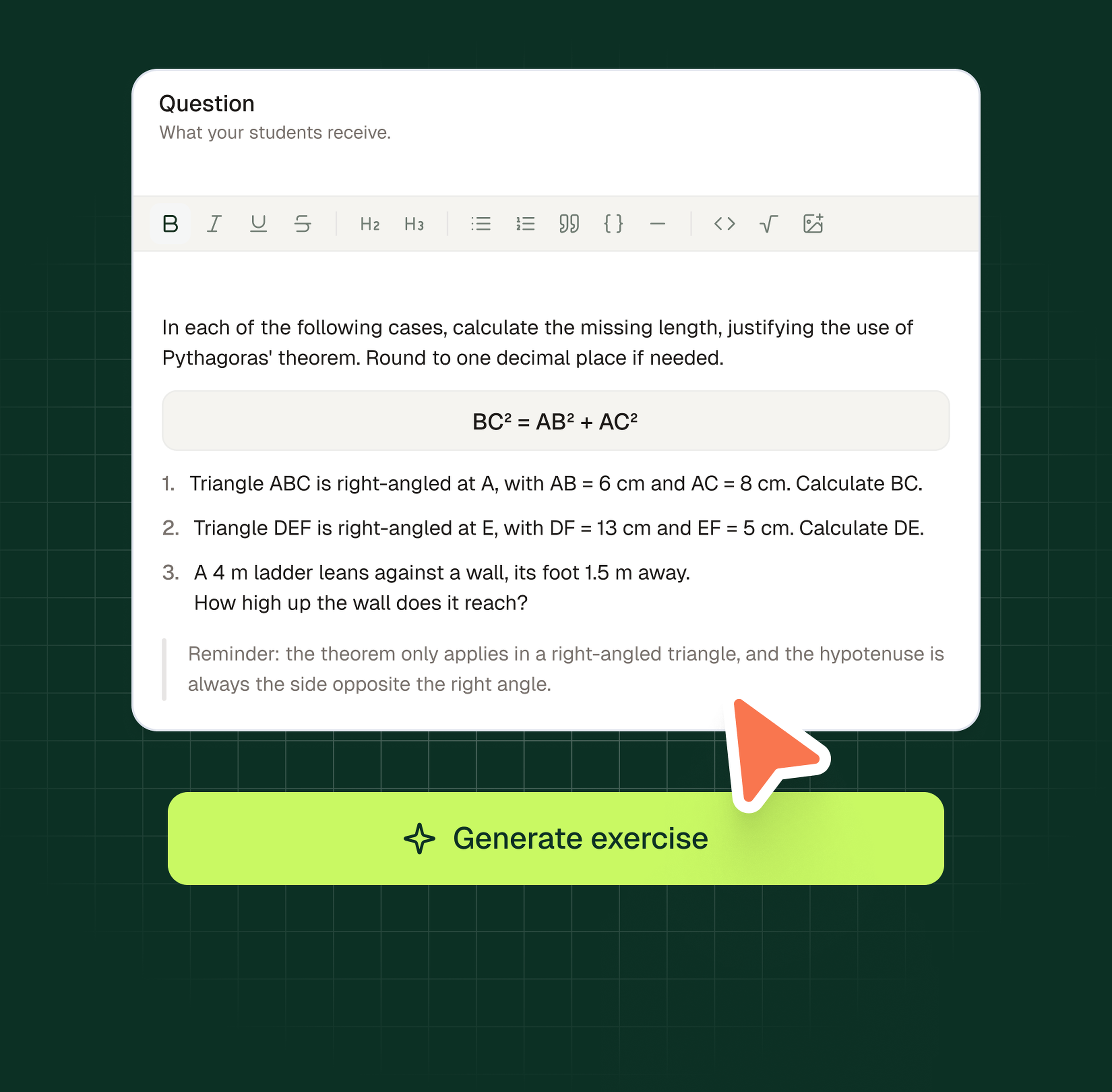
To get the most out of Examino, teachers must structure their assessments in a way that is adapted for artificial intelligence analysis. This initial preparation ensures accurate and reliable results during the automated grading of handwritten papers.
When designing assessment subjects, prioritize clear and unambiguous questions to facilitate tool recognition. Structure your marking scheme in detail by assigning precise points to each expected answer element. For scientific subjects, leave enough space for calculations so that the AI can follow the students' reasoning. In literary disciplines, define specific assessment criteria like argumentation quality or lexical richness that the system can identify.
Integrating Examino into the grading workflow
Integrating Examino into your usual grading process is done in a few simple steps. After collecting the papers, use your smartphone to digitize them before transferring them to the artificial intelligence platform for response analysis.
Since you need to verify the relevance of the analyses proposed by the tool, set aside time for reviewing automated grades. This check allows for adjusting any AI interpretation errors and adding personalized comments for students. You can then export the results to your digital work environment or your usual spreadsheet to integrate this data into your pedagogical follow-up. This use of Examino fits naturally into the existing workflow without requiring a complete overhaul of your assessment methods.
How Examino transforms assessment and learning
Data analysis to improve teaching
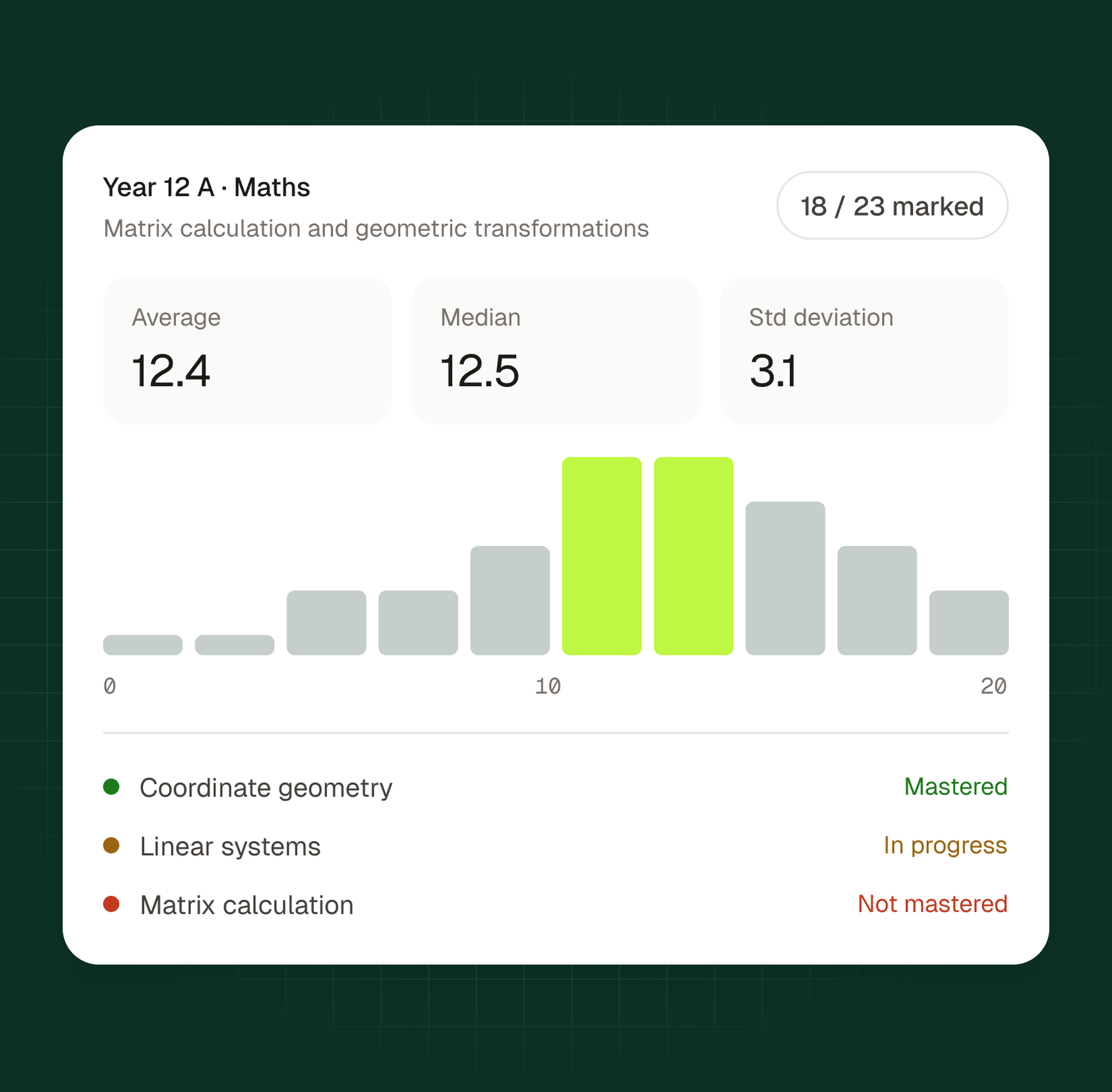
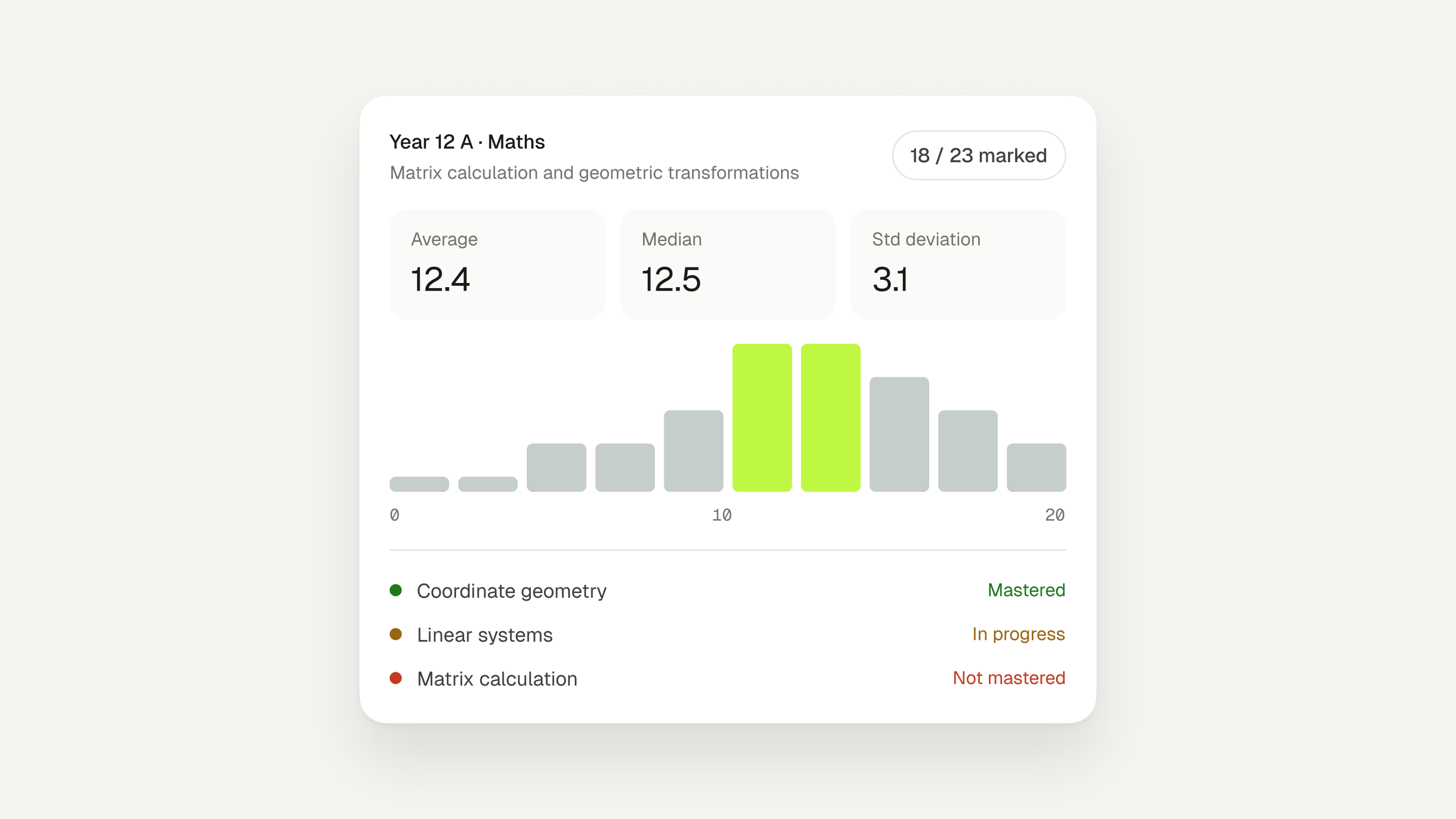
The data generated by Examino offers teachers a global view of class performance. This pedagogical use of artificial intelligence allows for the rapid identification of misunderstood concepts and the adaptation of teaching accordingly.
Examino's dashboards highlight collective and individual learning trends. When the teacher reviews the detailed reports, they can spot the questions that posed the most difficulty for the entire class. This analysis allows for precisely targeting the concepts to be reworked in upcoming sessions. Particularly useful after a formative assessment, this feedback helps reorganize pedagogical priorities and plan reinforcement sessions on identified weak points. Teachers can then create level-based groups to offer personalized interventions.
Personalizing feedback to students
Examino goes beyond simple grading by generating personalized feedback for each student. These constructive comments offer genuine pedagogical support that transforms assessment into a learning opportunity for students.
Examino's feedback generation mechanism analyzes the specific errors of each paper and proposes adapted comments. In mathematics, the tool can identify a recurring calculation error and suggest an alternative method to solve the equation. In literature, it can highlight argumentation qualities while pointing out weaknesses in the text structure. These detailed responses help students understand exactly where they went wrong and how to improve. Teachers report that students particularly appreciate this approach, which de-dramatizes error by turning it into a learning lever.
Reducing bias in assessment
Examino's artificial intelligence contributes significantly to reducing unconscious bias in assessment. The halo effect, grading fatigue, or prejudices related to student identity are minimized thanks to a more objective and systematic approach to grading.
Anonymizing papers is one of the main mechanisms ensuring fairness in assessment. When the teacher imports documents into Examino, student names are automatically masked during the grading process. Furthermore, applying the marking scheme is done uniformly for all papers, ensuring a consistency impossible to maintain manually over several dozen assessments. Teachers have testified to having discovered their own biases thanks to this approach. A humanities teacher notably observed discrepancies between their usual grades and those proposed by the AI for certain students.
Time savings and reallocation toward pedagogical support
Teachers using Examino save up to 6 hours per week on their grading tasks. This precious time is now reinvested in high-value pedagogical activities such as personalized support for struggling students and the preparation of more interactive and engaging sessions.
A middle school teacher explains that she now uses her Wednesday afternoons to organize improvement workshops rather than grading papers. A high school mathematics teacher has implemented targeted remediation sessions thanks to the time saved. These testimonials illustrate how Examino transforms the quality of teaching. Students benefit not only from more accurate feedback on their work but also from additional support time, which is particularly precious for those encountering learning difficulties.
Ethical considerations on using AI in education
Data protection and confidentiality
When using artificial intelligence tools like Examino, data security of students is a priority. The application implements strict measures to ensure information confidentiality, notably through hosting on servers located in the European Union, in accordance with GDPR provisions. Examino also integrates an anonymization system for papers for impartial assessment.
The Examino platform scrupulously respects data protection standards in force. Its website is hosted by a European provider, thus ensuring compliance with privacy regulations. Teachers should nevertheless remain vigilant regarding confidentiality issues. Some best practices include verifying paper storage terms after grading and informing students about the use of AI in the assessment process. These precautions allow for the ethical use of technological resources while preserving student personal data.
Balance between automation and human judgment
Artificial intelligence must remain an assistant and not a replacement for the teacher. Despite Examino's efficiency in grading, human intervention remains essential to evaluate the creativity and complexity of certain responses that the AI might misinterpret.
To use Examino optimally, teachers should adopt a balanced approach. This means entrusting the tool with objective grading tasks like mathematical calculations or single-answer questions, while keeping a critical eye on evaluations of more creative productions. Essays and literary analyses, for example, always benefit from attentive rereading. This complementarity between technology and human expertise allows for combining efficiency and pedagogical quality. Examino then becomes an amplification tool for teaching work rather than an autonomous grading system, thus preserving the authentic pedagogical relationship between teacher and students.
Algorithmic transparency and results understanding
Transparency in how Examino's algorithms work represents a fundamental issue. Teachers must understand the bases on which AI evaluates papers to explain these decisions to students and intervene in case of interpretation errors.
Significant efforts are necessary to make artificial intelligence decision-making mechanisms understandable by users. Currently, several educational platforms are developing interfaces that explain how grades are calculated and why certain responses are deemed incorrect. This transparency allows teachers to validate or adjust proposed assessments with full knowledge of the facts. Resources like user forums or specific tutorials help better understand how these tools work. A critical and reflective use of educational technologies thus comes through the mastery of their fundamental principles.
Developing teachers' digital skills
Teachers must continuously develop their digital skills to get the most out of Examino and other artificial intelligence tools. This continuous training allows them to maintain their professional autonomy and discerningly evaluate the technologies they integrate into their pedagogical practice.
Several free training paths are available to teachers wishing to enrich their digital literacy. The MOOC "Generative Technologies for Education" offered by FUN, the "Objective AI" training from the Academy of Paris, or even the introduction to generative tools by Le Wagon are excellent starting points. A free OpenAI account also allows for exploring ChatGPT's basic features in an educational context. Learning can happen gradually, starting with simple uses like grading MCQs before tackling more complex assessments. This gradual skill development facilitates the harmonious integration of digital tools into teaching.
Testimonials from teachers using Examino
Teachers who use Examino testify to considerable time savings in their daily work. They particularly appreciate the rapid grading of handwritten papers thanks to artificial intelligence. This solution allows them to focus more on personalized student support rather than time-consuming administrative tasks.
A history-geography teacher recounts how his grading time went from 45 to 15 minutes per batch of exams. A mathematics teacher highlights the consistency of assessment, which eliminates biases linked to fatigue during long grading sessions. A French teacher appreciates the quality of the tool's analyses, which precisely detect errors in essays. These Examino features allow users to recover about 25% of the time usually spent on grading. This freed-up time is generally reinvested in preparing more interactive pedagogical resources and in individualized support for struggling students. Teachers also observe improved consistency in their assessments and a significant reduction in stress linked to exam periods.
The future of artificial intelligence in education
Expected developments of Examino and upcoming innovations
Future developments for Examino include improving recognition algorithms and more advanced analysis capabilities. This artificial intelligence will continue to evolve to offer teachers even more precise support in evaluating handwritten papers and generating personalized feedback.
Examino could be enriched with features for adapting learning content and personalized tracking of student progress. Integration with digital work environments used in schools is among the development priorities. Since the application already effectively processes various response formats, from written text to geometric drawings, we can anticipate expansion toward analyzing new types of productions like recorded oral presentations or multimedia projects.
Trends in educational AI and new pedagogical uses
Adaptive learning represents one of the major trends of artificial intelligence in education. Platforms like ADAPTIV'MATH are already personalizing student paths by offering exercises that adjust precisely to their level. Intelligent virtual tutors and engagement analysis tools are also transforming the pedagogical relationship between teachers and students.
Beyond automating repetitive tasks, educational AI paves the way for innovative pedagogical approaches. Tools like Nolej allow teachers to create personalized educational content while EvidenceB helps them adapt their teaching to the specific needs of each student. This learning personalization contributes to reducing level gaps and better preparing young people for their professional lives.
FAQ about Examino and AI for teachers
Technical questions about using Examino
Teachers discovering Examino often wonder about its compatibility with different devices and technical requirements. The application works with any smartphone to digitize handwritten papers and import subjects in PDF format. Its intuitive handling guides the user through every step of the assessment process.
Here are the most common technical questions about Examino, along with their concise answers.
Account creation: Creating an Examino account requires an email address and a password, giving access to a free account limited to ten papers per month.
Digitizing papers: To digitize papers with a smartphone, use the device's camera to scan the handwritten pages directly into the application.
Importing the subject: Importing the assessment subject is done in PDF format, then allowing the AI to detect and pre-fill the marking scheme and expected answers.
Exporting results: Examino allows exporting detailed grades directly to other educational tools, facilitating integration with existing systems.
Modifying corrections: Examino's AI identifies errors, applies the marking scheme, and proposes objective and fair corrections, but the teacher can always manually modify the proposed corrections.
In case of technical issues, Examino offers video tutorials and complete online documentation. The user-friendly interface facilitates resolving common difficulties like importing documents or managing classes. For more complex questions, support remains accessible via the platform.
Pedagogical questions about AI integration
Teachers legitimately wonder about Examino's pedagogical impact in their daily practice. The tool integrates naturally into the assessment process while preserving the authority of the teacher who maintains final control over the grading.
The use of artificial intelligence in education raises fundamental questions about the evolution of the teaching profession. Teachers must now master these generative tools while developing their understanding of how algorithms work. This gradual transformation allows for integrating AI into lesson planning without sacrificing pedagogical quality. To communicate effectively with students and their families, it is best to explain how the tool improves assessment objectivity and allows for more time spent on personalized support.
Questions about free and paid offers
Examino's free trial allows teachers to test all features with a limit of 10 papers per month. This plan gives access to all grading and analysis tools, allowing to evaluate the service's relevance in a real teaching context. Educational institutions can also benefit from tailored pricing.
Free Version: Allows grading up to 10 papers per month, offering full access to all basic features for testing the tool in real teaching conditions.
Advanced Features: Paid versions offer advanced features such as detailed reports, increased grading capacity, and deeper integration with other pedagogical tools.
Paper Volume: The number of papers you can grade varies depending on the chosen plan, with options adapted to the needs of individual teachers and educational institutions.
Pricing: Paid subscriptions are offered at different rates, providing value for money adapted to each user's needs, with options for group purchases by institutions.
Paid versions offer considerable advantages for teachers managing many classes. Plans allow grading up to 300 papers monthly depending on the chosen subscription. The return on investment is tangible when considering that Examino saves about 6 hours per week for users, which is nearly 25% of the time usually spent on grading.
Questions about the future of AI in education
Artificial intelligence will profoundly transform education in the coming years, beyond just grading papers. Teachers will need to develop new digital skills by understanding how algorithms work and their pedagogical applications. Institutions that anticipate these changes will be able to leverage these innovations.
Among the emerging trends are hyper-automation of administrative tasks and generative AI for creating personalized educational resources. Tools like Examino already allow for automated management of assessment routines and the generation of adaptive materials. The gradual adoption of these technologies offers teachers the opportunity to position themselves as change agents rather than just undergoing it.
How to get started with Examino for free
Examino's artificial intelligence is accessible to all teachers thanks to its trial offer. Creating an account simply requires an email address and a password. This free plan provides access to all features and allows grading up to 10 papers each month. Trying Examino will allow you to discover how this tool transforms assessment.
Examino's use revolves around an intuitive three-step process. After creating your account, you will be able to select the grade level involved, from primary to doctoral. Then, import the assessment subject in PDF or image format, either directly from your computer or by scanning a QR code with your smartphone without needing to install an application. To digitize papers, simply use your phone's camera or import already-digitized documents. As soon as the marking scheme is validated, the artificial intelligence quickly analyzes the content and proposes corrections that you can adjust before generating final grades.
To maximize the use of your free monthly quota of 10 papers, prioritize complex assessments that usually require a lot of grading time. The tool works particularly well with extended-response questions and written productions, where artificial intelligence can truly save time for teachers. Test different subjects to explore Examino's analysis capabilities, which adapt to both mathematics and humanities.
Examino comes with pedagogical resources that facilitate its onboarding. Online tutorials and detailed user guides are accessible to new users to optimize learning the tool. These free trainings allow to quickly master all features available in the trial version.
Try Examino for free
The app lets you scan your handwritten papers using your smartphone to grade them with Artificial Intelligence.
Maximize your teaching impact by minimizing your grading workload.
Examino, a revolution in school assessment
Examino provides teachers with an artificial intelligence tool that radically transforms paper grading. Its rapid analysis, constant objectivity, and intuitive interface allow teachers to save precious time while maintaining high pedagogical quality. The free trial offers an ideal opportunity to test its features under real conditions.
In a rapidly changing educational context, tools like Examino are redefining the teaching profession. By automating time-consuming grading tasks, this technological resource allows teachers to return to the heart of their mission: personalized student support. Artificial intelligence thus becomes an assistant that frees up time for enriching human interactions and in-depth pedagogical work on the specific needs of each student.
We invite you to try Examino for free starting today. In a few clicks, you will discover how this tool transforms paper grading, saves you up to six hours per week, and improves the quality of your assessments. The free offer of ten papers per month allows you to explore all features with no strings attached.
The future of education is being shaped by solutions like Examino, which allow for more personalized teaching. By freeing teachers from repetitive tasks, artificial intelligence creates space to develop essential skills like empathy, creativity, and critical thinking – human qualities that are irreplaceable in shaping future generations.
Examino transforms teachers' work by providing a free and effective solution for grading papers. Thanks to this artificial intelligence adapted for the educational context, teachers save up to 6 hours per week that they can dedicate to personalized student support. The free trial lets you test all features with 10 monthly papers. Don't wait any longer to transform your assessment experience and free up time for what really matters: the quality of your teaching.