

The 60-Minute Challenge: A Concrete Method for Mass Grading
The Setup: Preparing Your Grading Session
Speed starts with preparation. You must digitize papers first. Tools like Examino now process handwritten copies, removing the biggest bottleneck. The goal is simple: get every document into a digital format ready for analysis.
Next, you define the rubric. This is the foundation of consistent grading. You translate your specific pedagogical criteria into precise data points that the AI can strictly follow.
This grid is fully customizable. You do not adapt to the AI's logic; you force it to apply yours.
The Process: Grading 100 Essays in One Hour
We use a structured three-step workflow to hit this velocity. It is not magic; it is simply an optimized production line.
Upload & Calibration (10 minutes): Upload the batch at once. The AI aligns with your rubric by analyzing a few samples you validate.
Automated Grading Run (20 minutes): Launch mass correction. The AI applies the grid to all 100 copies, spotting errors and proposing grades.
Review & Validation (30 minutes): Scan the results. You focus on borderline cases, adjust scores if needed, and validate. The heavy lifting is done.
The Proof: A Teacher's Real-World Results
Consider Emmanuelle Deglaire's experience at Edhec. For her law essays, the manual process was exhausting. The mental load of maintaining objectivity over hours is a known pain point. She needed a solution to handle the volume without sacrificing precision.
By using an ai essay grading assistant, her correction time was effectively divided by three. She describes the tool as a necessary "guardrail" that pre-fills the rubric for final verification.
This isn't just faster. The grading quality remains high, ensuring fair assessment and detailed feedback across the entire cohort.
Beyond Speed: How AI Ensures Fairness and Consistency
Speed is impressive, but speed without quality is dangerous. Now that we have seen the method to save time, let's look at an equally important benefit: the quality and fairness of grading.
Eliminating Grader Fatigue and Bias
You know the feeling well. By the time you reach the tenth paper, your eyes glaze over. The harsh reality is that the first student gets a fresh, attentive review, while the last one gets a tired glance. It is a known bias.
Machines do not have moods. An ai essay grading tool applies your specific rubric to the 100th essay exactly as it did to the very first one. It never loses focus or patience.
The result is a strictly objective evaluation and fairness for every single student.
The Power of Custom Rubrics
You remain the master of the game thanks to custom rubrics. You define exactly what matters, and the AI executes your vision without deviation.
The AI is calibrated to evaluate precisely what you demand. This includes:
Reasoning and argumentation: The tool verifies if the student followed a logical structure.
Use of specific concepts: It ensures key course terms were applied correctly.
Essay structure: It analyzes the introduction, body, and conclusion based on your criteria.
Grammar and style: It identifies language errors while respecting your specific style guidelines.
Consistent Feedback for Every Student
Providing detailed returns to every student is a struggle when you have dozens of copies. Often, comments become scarce or repetitive simply because time runs out. You miss the chance to offer deep pedagogical support.
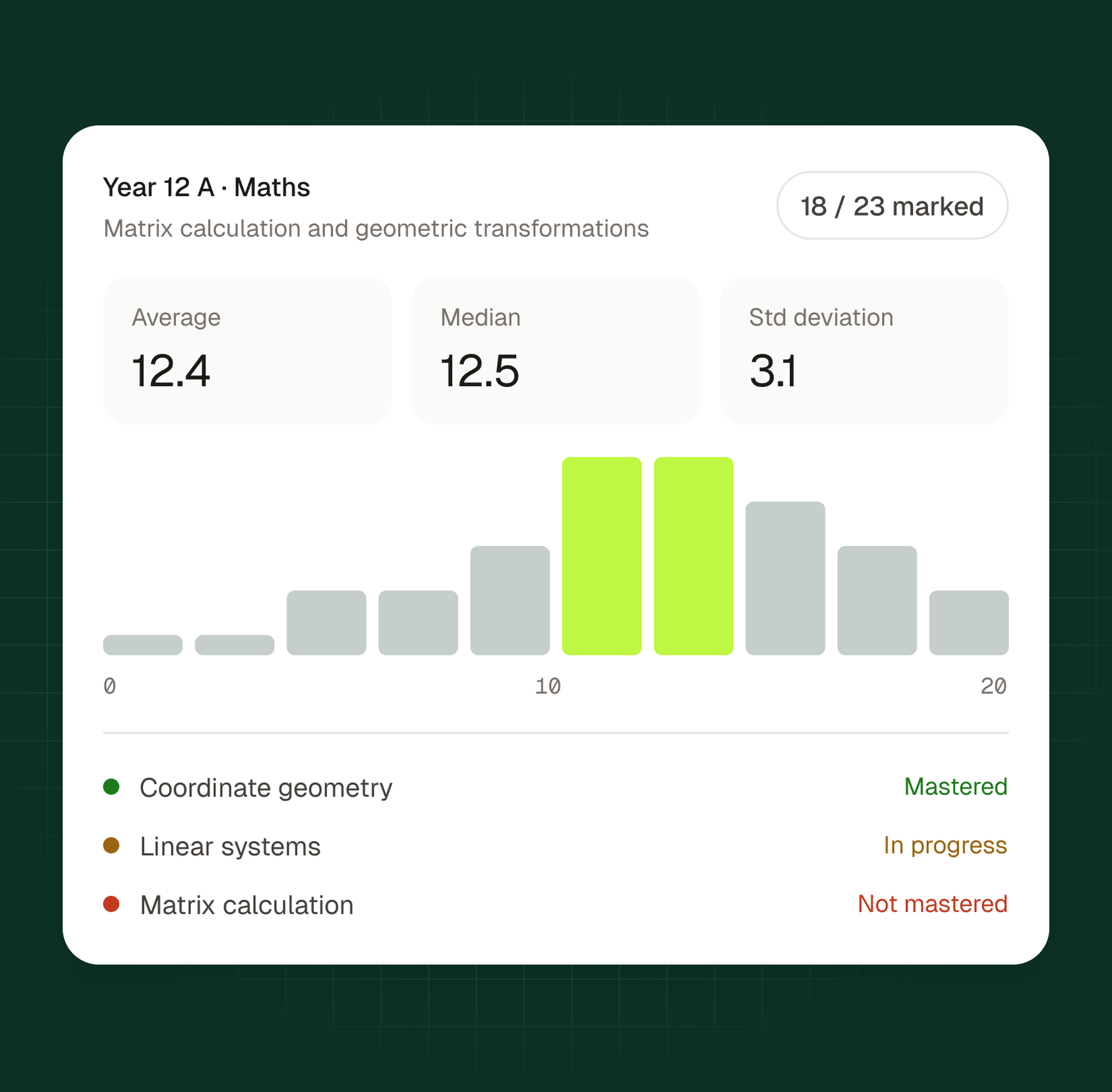
Tools like Examino allow you to generate individualized comments based on the rubric. Every error or strength is associated with a specific explanation defined by the teacher.
The student receives a complete return that truly helps them progress. The feedback is standardized yet personal.
The Mechanics of an AI Grading Assistant
From Handwriting to Digital Text
Most exams still happen on paper. This physical reality is a massive brake on digitization. You cannot analyze what a computer cannot see, leaving teachers stuck manually deciphering every word.
Solutions like Examino utilize advanced Optical Character Recognition (OCR) technology. Teachers simply scan or photograph the handwritten sheets. The application instantly transforms that ink into digital text, ready for AI analysis. This conversion is the absolute key to unlocking ai essay grading.
Analyzing Content, Structure, and Reasoning
The AI doesn't just hunt for keywords. It is trained to grasp complex aspects like the quality of argumentation and the text's logical structure. It looks at how ideas connect, moving far beyond simple vocabulary matching or surface-level checks.
The system segments the text into introduction, body paragraphs, and conclusion. It then evaluates the coherence of each section directly against the criteria in your grading rubric.
This allows for an evaluation that goes far deeper than simple orthographic correction. It assesses the student's actual reasoning capabilities.
How Feedback is Generated and Applied
Feedback is never generated randomly or out of thin air. It is strictly tied to the specific criteria defined in the teacher's grading grid.
When the AI spots a weakness, like an unsupported argument, it applies the comment you prepared for that scenario. A modern AI essay grader enables you to build a robust bank of reusable observations.
This ensures the feedback remains pertinent, personalized, and strictly aligned with your specific pedagogical objectives.
Reclaiming Your Time: What to Do With the Hours You Save
From Grading Drone to Teaching Mentor
We know the drill. You spend endless evenings and weekends buried under stacks of paper. This repetitive grind drains your energy, leaving zero room for lesson planning or tracking student progress. It is, quite frankly, a burnout recipe for educators.
Here is the shift. By slashing correction time—some report a 50% reduction in administrative load—you finally tackle tasks with higher value. Tools like Examino handle the heavy lifting of ai essay grading, letting you return to what matters most.
Focusing on High-Impact Pedagogical Tasks
So, what happens with this found time? The options are vast and, honestly, much more rewarding than circling typos until midnight. It opens new doors.
Here are examples of what educators do with the up to 6 hours per week saved:
Personalized Support: Hosting one-on-one sessions for struggling students.
Course Prep: Building engaging activities and innovating pedagogy.
Data Analysis: Using AI reports to spot class-wide hurdles.
Professional Development: Training on new teaching approaches.
Improving Student Interaction and Support
That saved time translates directly into availability for your students. While the AI handles the mechanical processing, you manage the human connection. That is the core philosophy. You aren't replaced; you are empowered to be present when it counts.
You spend class time interacting, debating, and guiding, rather than dreading the mountain of copies waiting at home. The mental load drops significantly.
Ultimately, AI acts as an enrichment tool for teaching practice, never a substitute for your expertise.
You Are Still the Expert: Keeping the Teacher in Control
Ai as an Assistant, Not a Replacement
Let's address the elephant in the room immediately. Does using ai essay grading mean giving up your professional judgment? The answer is a definitive no. We position the algorithm strictly as a tireless correction assistant, never the master.
The AI handles the tedious first read-through instantly, saving you hours of work. It proposes a grade and drafts detailed feedback based on your specific rubric. However, the final decision always rests in your hands. It is decision support, not automated decision-making.
The Importance of the Final Validation Step
This is where the "Review & Validation" stage becomes central to the process. Your human expertise remains the only filter that truly matters here. No algorithm can replace your pedagogical instinct.
You can easily adjust a score if the AI misses a subtle creative nuance or idea. You have full power to modify, add, or delete specific comments. The system adapts to your standards, so the feedback sounds like you.
This total control guarantees that the evaluation remains fair and deeply human. You simply work much faster.
Maintaining Your Pedagogical Authority
Using these tools actually strengthens your pedagogical authority rather than diminishing it. You demonstrate that you use modern methods to be more efficient. Students respect a teacher who leverages technology to provide faster, better feedback.
You can justify every point of your grading objectively by referring to the rubric applied uniformly across all copies. For educators who want to go deeper, a complete teacher's guide to AI grading offers strategies to integrate these tools effectively. It simplifies the justification process significantly.
Try Examino for free
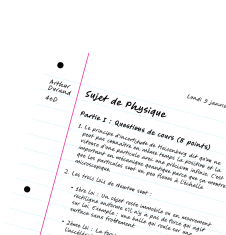
The app lets you scan your handwritten papers using your smartphone to grade them with Artificial Intelligence.
Maximize your teaching impact by minimizing your grading workload.
Navigating the New Classroom: Challenges and Responsible Use
The Student vs. AI Writing Dilemma
Let's face the elephant in the room regarding ai essay grading. While we use these tools to speed up corrections, students are using the same tech to write. It creates a strange feedback loop in education. We are essentially watching algorithms grade other algorithms.
Fortunately, modern tools often include robust AI content detectors to spot these fabrications. Platforms like Copyleaks help flag generated text immediately inside the workflow. This restores a necessary layer of integrity to the evaluation process.
Yet, the smartest fix involves changing the assignments themselves. We must demand personal reasoning that a bot simply cannot fake.
Data Privacy and Security Concerns
You might worry about where those essays actually go once scanned. Do they feed a public database somewhere? Are student thoughts being used to train the next GPT model? These are valid fears that every educator should have.
Reliable platforms guarantee strict data privacy by design. They comply with major regulations like FERPA and GDPR to protect student identity effectively. Your students' work stays private and never trains public AI models. We prioritize security so you don't have to stress about data leaks or legal compliance issues.
Best Practices for Ethical Integration
We need clear rules for this new reality in our schools. Start by being totally transparent with your class about how you use these tools. Honesty builds the trust required for this technology to work.
Always treat this technology strictly as a pre-correction mechanism. You should never blindly accept a grade generated by a machine without review. Look at every suggestion critically. You remain the final judge of quality, not the algorithm.
For specific strategies, read our guide on practical tips for teachers to handle these questions. It helps you navigate these ethical waters safely.
Adopting AI grading transforms a tedious burden into a streamlined process. Tools like Examino allow you to grade 100 essays in an hour without sacrificing fairness or control. By reclaiming this valuable time, you focus on what truly matters: mentoring students and enhancing their learning experience.